Do you have any photos of historic railway stations? If so, then we'd love to have them at the ABC Railway Guide

Do you own a listed building that you're planning to restore or convert? If so, then Channel 4's Restoration Man would like to hear from you. See here for more details


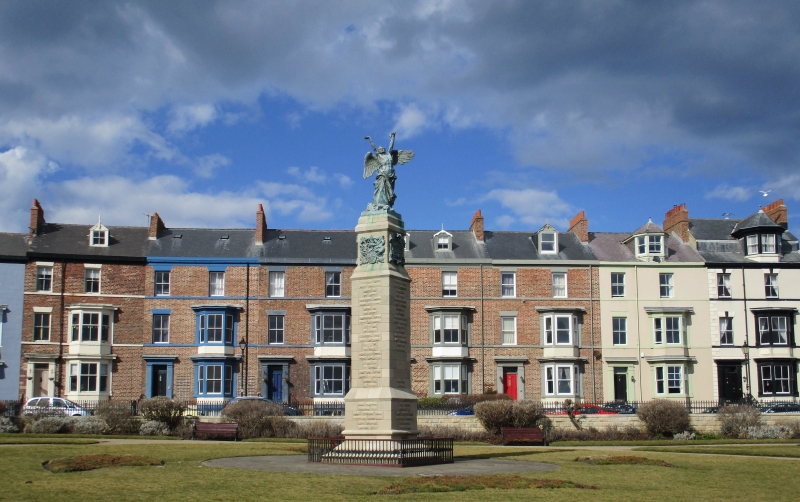
War Memorial in Redheugh Gardens, Hartlepool

Description: War Memorial in Redheugh Gardens

Grade: II
Date Listed: 17 December 1985
English Heritage Building ID: 432718

OS Grid Reference: NZ5315233729
OS Grid Coordinates: 453152, 533729
Latitude/Longitude: 54.6958, -1.1768

Location: Radcliffe Terrace, Hartlepool TS24 0QN

Locality: Hartlepool
Local Authority: Hartlepool
County: Durham
Country: England
Postcode: TS24 0QN


We have 23 comments on this building so far. Why don't you give us your comments as well?

Comments

I have made use within References in http://en.wikipedia.org/wiki/Talk:West_Hartlepool_War_Memorial of the very relevant photograph now added to your website. Incidentally I wish to confirm that as stated on Wikipedia Talk References the correct name of the statue by Philip Bennison as stated first in the local press (Northern Daily Mail 17 December 1921) and (immediately afterwards) by the inclusion of a copy of the newspaper report within the minutes of Hartlepool Borough Council is indeed not 'Winged Victory' but 'Triumphant Youth'. It can further be confirmed by anyone visiting the site that the date given on one of the four cartouchs on the shaft (illustrating four soldiers manning a gun, this being the number killed by the first two shells from the flagship of the German High Sea Fleet ships carrying out the attack on 16 December 1914) is '1914' together with the inscription FOR US THEY DIED. Thanks again and I hope all this is in order, my sincere thanks also to the photographer Stan Laundon, in the hope that photographs will help to clarify the rather complicated issues that seem to arise in connection with the war memorials within what was formerly known until the 1960s as the 'Hartlepools'. In conclusion I can confirm that I have repeatedly over many years attempted to have these and other matters clarified both with the owners, Hartlepool Borough Council (councillors and officers) and the Administrative Court of the RCJ, but without success in either case so far at least. This is a long-running affair but it must eventually conclude.

Peter Judge, 29 September 2010

PS In the above text, for 'cartouch' please read 'cartouche'.

PJ, 30 September 2010

I have today received a certain historic postcard through the Internet (Ebay) undated but with postal date 1929 and entitled 'promenade and breakwater' with reference to both the 'promenade' as laid out early in the 20th Cent. along the coast of historic Hartlepool and Redheugh Gardens.
The bad news is that I am not sure how to make it available on your site. It is extremely relevant, I believe.
Perhaps somebody can let me know (or even do this for me)?
In the meantime, I confirm that the description of this memorial as a 'building' is rather misleading, together with the dates, as under the listing description.
So persons within English Heritage, as responsible for listed building descriptions, or indeed anyone else, if they have the time and the inclination, may be interested in the suggestion made by myself today in http://en.wikipedia.org/wiki/User_talk:ClueBot_Commons#Re._User_talk:82.1.67.40.
Au revoir. Thank you for publishing my previous comment.

Peter Judge, 23 November 2010

(This would incidentally, as those who have actually visited the site will perhaps be aware, relate to the possible connection, if there is one, between the two separate monumental structures within Redheugh Gardens, one of which is here illustrated and is central with the date '1914' and the other consisting of a list of names including civilians which is not shown in the photograph and which is included within the wall of the garden, carrying the dates 1914-1919. Only one of these--the shaft and statue with the date 191--is referred to in the listing description, which thus avoids altogether the true character of the memorial as a whole. I repeat all of these are extremely complicated matters relating to the Promenade as a whole and including the 'war memorial tablet' on the coast to the north, and relating to the East Coast Raid in December 1914, but the postcard, the publisher of which is not stated, would perhaps, if nothing else, indicate the possible nature of its complexity.) Peter Judge, 9 February 2011

Peter Judge, 9 February 2011

PS '191' should, as will perhaps be understood, read '1914'. PJ

Peter Judge, 9 February 2011

This is indeed a most intreguing matter Peter, that must be noted. I must congratulate you on your dilligence regarding the complexities of this case.

Reginald Blight, 10 February 2011

What you say about complexity, Reginald, is true, and in effect dates as from the end of the Second World War, when things were done which made all things become difficult to understand so far as the First World War memorials were concerned, assuming they had ever been fully understood at all; for each memorial to the dead which is of significance additional to the names of any person or persons who have died to which it might happen to relate (that is, if it is erected with a view to historical significance, and if it has any historical meaning at all) has historical meaning in relation to the period when it was constructed. This is surely common sense, but was ignored by the government in this country, and possibly in others, after the Second World War, for whatever reason (I refer to first the use of the cenotaph in Whitehall for both 'world wars' and subsequently in 1946 parliamentary legislation relating to war memorials in general, as controlled by local authorities who had accepted them as gifts in principle 'in the public interest', that is with their names and their architectural character as originally had been intended and as they had been accepted, but giving them in principle, except of course where what was in question was a charitable gift accepted 'to be kept for the inhabitants for all time', as in the case of the West Hartlepool War Memorial, authority to carry out changes, and not even this made any difference so far as this particular war memorial was concerned or to that in Middlesbrough, with certain admittedly limited changes also authorized to the Scottish National War Memorial on Edinburgh Castle).
You are Reginald I believe correct in supposing that this is a difficult problem for any individual, anyway certainly for myself, and it has taken up a good deal of time and trouble. I coubt whether this is going to be possible easily, or at all, but I nonetheless continue to believe it is necessary in principle that it should be ultimately resolved. Thank you again for your encouragement in stating that these things should be noted. We must follow them through. (In the meantime I correct the website as quoted earlier, which has now changed to http://en.wikipedia.org/wiki/User_talk:ClueBot_Commons/Archives/2010/November#Re._User_talk:82.1.67.40.)
Peter Judge 12 February 2011

Peter Judge, 12 February 2011

PS (1) '1946' should be read as referring to the year in which the monarch (King George VI) agreed to the addition, as proposed by the Prime Minister, of further war dates to the cenotaph in Whitehall, London, the amendments so far as the council of a county, district or parish was concerned, and with reference to all war memorials whether owned by themself or not, being that of the War Memorials (Local Authorities Powers) Act 1923 as amended by section 133 (1) and (2) of the Local Government Act 1948 and Schedule 30 of the Local Government Act 1972; (2) for 'I coubt ...' please read 'I doubt ...'

Peter Judge, 13 February 2011

Two days ago I predicted difficulty, which certainly must be held to remain. What is also true is what I now appreciate even better by having today, Reginald, come across another postcard, issued before the 1914-1918 war but immediately relevant to the one to which I have already here referred, believe it or not! This must now lead to dealing, in the first instance, with the possibly relevant officer in a party of governmental character given the clear (if likewise incredible in principle) relationship of both postcards with newspaper material and the minutes of Hartlepool Borough Council (minutes of 7 December 1921, available at Teesside Archives, Middlesbrough, the newspaper of date 17th of the same month being held at the Central Library, York Road, Hartlepool, the minutes themselves containing an addition in the form of the 17 December 'Northern Daily Mail' newspaper articles in a particular form which makes them even more relevant to the character of Hartlepool War Memorial than in the newspaper itself, notwithstanding that in strict legal interpretation the artwork, which is signed by the designer of the memorial Philip Bennison himself, which it contains happens to be inaccurate in two senses, and thus possibly in principle contrary to the 1907 Perjury Act at section 10 relating to public documents, but 'in principle' only, since it is quite clearly deliberate on the part of both the artist and the Council for a particular purpose relating to an understanding of the character of the memorial in the strict sense and its relationship with other local elements within the Promenade).
The outcome, with particular immediate reference to the suggested chartacter of a male figure as a 'Winged Victory' within the listing description, remains of course to be seen (this is a long running matter).
I shall of course try to let you Reginald and anyone else interested know here on this site, briefly, what the outcome is, or might be, and the reasons, within I hope a couple of weeks ... (Did either Council minutes or postcards or a newspaper ever relate to history in this form at any time, anywhere, let alone all three together? It is however only part of the complexity at least for myself to which I refer and this 1914-1918 war ended in a likewise completely unprecedented fashion which can never be repeated!)

Peter Judge, 14 February 2011

I am myself alas careless in failing to check references to documents before contributing possible comments on this page. I now have to correct the year in which the Perjury Act (a parliamentary Act which is I myself believe of the utmost significance if the concept of democracy is to mean anything at all within the United Kingdom) from 1907 to four years later, 1911, and the section of the Act which is possibly immediately relevant to the issues here discussed, in the rather disconcerting way that is made clear in the Act (involving the possibility of criminal offence), is section 5, not 10. I sincerely apologize for irresponsible errors and hope this sort of mistake will not be repeated.

Peter Judge, 15 February 2011

PS My reference on the 14th to the Perjury Act (which should actually have been dated 1911 not 1907 and at the section 5 not 10) can be confirmed in detail on http://www.legislation.gov.uk/ukpga/Geo5/1-2/6.

Peter Judge, 15 February 2011

While I thank you, ladies and gentlemen of this website, for your patience, I am afraid I am unable to understand why you believe that I wanted all the versions of different photographs to be included, since I imagine you could substitute for an earlier version a new version which evidently was more correct for an old one, but photographically identical? You did not do so! I repeat I remain grateful, also for the publication of comments, given the immense difficulties that attach to 'listed buildings'. I now add to this 'Comments' page the 'Description' included with my most recent attempt to submit a photograph (once again identical as a photograph with two or three others, an attempt to submit a section of that photograph rather than the whole picture in order to distinguish it having for reasons I shall probably never understand failed about three times in succession). Here it is, in full, as I hope it will appear with the photograph.

"The above is a section of the postcard with Post Office date 1929, and entitled as shown ('Promenade and Breakwater, Hartlepool').
This postcard is now shown here on this site in several versions, but this was not however my intention since I had, rightly or wrongly, expected it to be understood that whatever I was submitting was (given it was in effect visually identical) intended as a version to be used for replacement of what had already been sent in order to correct errors; the present version is however submitted with the hope that it will be taken into account separately from any of the others.
So far as the 'Hartlepool War Memorial 1914' (as originally named) together with the accompanying stone screen dated 1914-1919 and separately unveiled are concerned the immediately relevant features within the postcard as a whole are two: (1) the Promenade (as from the left hand side of the postcard to the Breakwater) and (2) the architecture on the border of the Redheugh Gardens, including the screen, as shown on the Promenade in the form shadows. I shall now try to explain this as briefly as possible (this being of course an entirely personal view). These two features are related to each other insofar as in each case the shadow of the Gardens memorial which can be seen on the Promenade (evidently as a result of the postcard photograph, described on the obverse as a 'Real Photograph', having been taken at a particular time of day and of year when the sun was going down in the northwest and was 'in line' with the architectural features) is in the centre, with the length on each side being 2 3/4" on the Promenade, as between the left hand side of the postcard and the Breakwater (totalling 5 1/2") and 1" within the Redheugh Gardens boundary wall, as from the end of the architectural features on each side (totalling 2"). The length from the middle point of the righthand section (these being features containing seating) to the top of the postcard is likewise 2".
An attempt by myself to explain all these features at least in part (taking into account the apparently pointless timber constructions in 1929 extending from the centre of the seating sections on the Promenade into the Redheugh Gardens, as can be seen on this section of the postcard if it is carefully inspected) will be submitted on the Comments Page as soon as possible after this photograph is as I hope (that is together with the present description) published, with particular reference being made to the useful 'Bing Map/Birds Eye View', which contains a scale.
In the meantime it may be useful for those interested to consult http://www.geograph.org.uk/photo/1608078 to clarify what is evidently meant by the title 'Memorial' next to the lighthouse on 'OS Map' (the correct insofar as official title being 'War Memorial Tablet', this having been unveiled on 17 December 1921, seven years and one day after the East Coast Raid in 1914, that is on the same occasion as the two sections of the 'Hartlepool War Memorial' in Redheugh Gardens, if in each case by different persons). "

Peter Judge, 26 February 2011

I refer to the postcard posted in 1929 and now published here on the Photos page, together with an attempt at explanation (see copy in the form of a comment by myself above on this page, dated 26 February).
I confirm that what the Ordance Survey plans and other official documents can confirm is that the entire site at the time of the East Coast Raid in 1914 was in the form of an extensive Promenade laid out in accordance with the 1885 Hartlepool Headland Protection Act, carrying into effect an award of May 1882 by the Rt. Hon. Joseph Chamberlain MP togther with other contributions, and extending from the Headland Lighthouse along or near the line of the cliffs or seashore and terminating on or near the northern end of Corporation-road with (as can be seen right here on the Bing Map) a 'quadrangle' or rectangular section on the Promenade which was used for public recreation and also for the official celebration of Empire Day. There was at the time to the southeast of this in some ways central feature (the 'quadrangle') a War Office Coastal Defence Unit comprising the Heugh and the Lighthouse Batteries and to the northwest a Coastgard Signalling Station, both carrying Union Jacks. An Admiralty Coastgard Station had been constructed next to Sea View Terrace at the northwest end of the Promenade and immediately related (given that the military stationed within it manned the Coastal Defence Unit on the Promenade and also others nearby) there was in West Hartlepool an Armoury functioning as regional headquarters of the Durham Royal Garrison Artillery, located upon a 'Parade Ground' also referred to as the 'Armoury Field', this Armoury also carrying a Union Jack.
This 'listed building' must I suggest perhaps (given they occupy separate positions on land held by the Council for a statutory purpose) be held to include at the very least what in point of legal definition under the relevant legislation are two separate buildings, one dated 1914 within Redheugh Gardens and the other in effect on the Promenade and containing memorial tablets showing names of the military dead in the 'Great War' as it is there named, together with civilians killed in the East Coast Raid, with dates 1914 to 1919, if not together with a third, the 'War Memorial Tablet' on the Lighthouse Slope, all of these having been unveiled on the same day, seven years and one day after the raid. I now suggest further that the question must arise whether what should be included as architecture of historical significance is in fact the entire Promenade even if some of its original features no longer exist, in accordance with the provisions of the 1985 Granada Convention to which this country is a signatory.
This however is presumably an issue which is not only complicated as arguably involving national issues in relation to war memorials throughout the United Kingdom but cannot perhaps be correctly here discussed on this page; so far as what is immediately relevant is concerned I hope to be submitting as soon as possible some further photographs including one of the Lighthouse Slope; they will again come with an explanatory comment (likewise provided here by myself and for which I shall myself be entirely responsible so far as either its accuracy or its relevance, if any, in terms of national and European history is concerned).

Peter Judge, 2 March 2011

Twelve days have passed since I said here that I was going to make a further contribution to this page, together with photographs by myself submitted on the Photo page.
It should not be concluded by those who read this page that this time has elapsed because I have lost interest in this subject matter. Nonetheless, having previously said that I preferred not to deal with what I called 'national' issues of architecture and history (and indeed they could not perhaps in any event be dealt with on this page?) I have now (as ever rightly or wrongly) come to the conclusion that they cannot (given the strange history of this matter, architectural and historical, both before and after the First World War) be separated from those I had thought could perhaps be described as 'local' to the 'Hartlepools' (as at the time the two local government authorities were called).
The immediate issue of the accuracy of the description by (in the first instance, presumably, and relatively recently, that is, after the Second World War) both the newly created local authority 'Hartlepool' (covering both areas of the 'Hartlepools') and by English Heritage (likewise created after that war) of the 'listed building' (as this is defined in general in the immediately relevant legislation) as one structure only (representing a Greek goddess known as a 'Winged Victory', and covering the entire period of the First World War) is however I now conclude presumably both local and national at the same time.
It furthermore (I suggest) involves a description which is contrary perhaps to simple common sense, the inscription on the 'War Memorial Tablet' on the Lighthouse Slope reading "THIS TABLET MARKS THE PLACE / WHERE THE FIRST SHELL FROM THE / LEADING GERMAN BATTLECRUISER / STRUCK AT 8.10 A.M. ON THE / 16TH OF DECEMBER 1914 / AND ALSO RECORDS THE PLACE WHERE / (DURING THE BOMBARDMENT) / THE FIRST SOLDIER WAS KILLED / ON BRITISH SOIL BY ENEMY ACTION / IN THE GREAT WAR 1914 - 1918" and the evidently immediately relevant side of the memorial on the Redheugh Gardens carrying at the base a further tablet recording the opening seven years and one day later (at the same time as the 'War Memorial Tablet' as it is named in the Council minutes), with on the shaft the inscription "FOR US THEY DIED" and on the pedestal a cartouche with shells surrounding the Heugh Lighthouse carrying '19' on one side and '14' on the other, together with a gun and four soldiers (this being the number killed by the first two shells, these Council minutes also providing the title 'Triumphant Youth' next to a representation of the monument in the form of artwork by the architect Philip Bennison, all as first published in the local press of date 17-12-1921 and later included with the Council minutes of 7-12-1921 as an appendix).
I regret that I now at least for the time being doubt whether there is much more I can usefully say on these issues, whether they are local or national or both (too many notable people directly involved?).
Let us in any event, ladies and genlemen of England and of the 'United Kingdom', and whatever I do or do not say (and however long it takes me, please forgive me, to say it) for the sake of the future as well as the present, please do what we can to stick to the facts, whatever the cost and whatever the number of (politically) 'notable people' potentially involved, even if due respect them, together with the monarch, is something we must in principle always cultivate; for, regardless of an intervening world war, it was our history as a nation together with that of others which was in question (and still is, given the truly architectural character of 'memorials' together with their location, in the present instance an entire coastal Promenade as indicated in outline on the Bing Map); for the history of what was, at one time, known as the 'British Empire' and is now a Commonwealth is surely, in one sense, the history of our 'united' coast, as from the 1707 Act of Union?
I suggest this history can be taken together with the history (as from the 19th Cent.) of our national and (as from much earlier) our Admiralty flag, the 'Union Jack', together with our 'national' maps, the Ordance Survey, in particular at the scale of 1:2500, at which scale the length between the two seatings on the Promenade on the boundary wall of the Redheugh Gardens (shown as two inches on the original postcard now included here in copied form on the Photos page, with postal date 1929) happens to be exactly one third of an inch (69 feet/21m) this being an architectural and Ordnance Survey feature which preceded the 'Great War' as it was called at the time together with the new layout of what was previously named a 'play ground' and was renamed the 'Redheugh Gardens' (something rather different from a play ground, yet it was almost exactly the same location, even if with certain differences in features, including the central circular section).
These seatings can be considered (together with the Redheugh Gardens and the Lighthouse Slope and of course the section of memorial erected at a central position within the space between the seatings, as shown on Photos) in one particular historical sense part of the memorial here in question (something incidentally confirmed within 1921 Council minutes in the form of the artwork of Philip Bennison - but indeed our extraordinary and catastrophical next war from 1939 to 1945 created, like all wars, that which was, from a political point of view, a 'new world', there having already of course been various changes in the inter-war period leading to our presentday Commonwealth, that which at the time of creation of the monument can hardly have been foreseen even if the possible difficulties lying ahead were it seems very much in the mind of the artist!).
PS I consider rightly or wrongly that these matters can hardly be considered as simply an error within this site as such, but are quite obviously, and together with other related ones elsewhere, a national issue involving the governmental parties here identified and possibly others; they are not therefore reported, at least by myself, elsewhere within it.

Peter Judge, 10 March 2011

For "with the length on each side being 2 3/4" on the Promenade, as between the left hand side of the postcard and the Breakwater (totalling 5 1/2")" in my own comment of 26 February this year, which relates to the postcard shown on the Photos page, please read "with the length on each side being 7cm on the Promenade, as between the left hand side of the postcard and the Breakwater (totalling 14cm)", this being the measurement, slightly longer than 5 1/2"/13.97cm, which corresponds precisely to that along the top of the sea wall on this (undated) post-war postcard as published. It will be appreciated if this correction can be made available to readers since it relates directly to the issue of the 'battle of the scales' as reflected in Ordance Survey maps of the Hartlepool Promenade and other postcards of pre-war issue, as from the end of the 19th Cent. and the creation of the new Promenade.

Peter Judge, 2 May 2011

An attempt is now (30 October 2011) made (after what I have to say is the continued as over many years complete indifference of governmental departments) on the Talk Page of the article on the West Hartlepool War Memorial in Wikpedia (www.en.wikipedia.org) under the title "'Relevance' or 'connection' of First World War memorials to the architectural form, as from the 19th Cent., of Buckingham Palace in London", emphasizing the international issues which are quite clearly in my own view in question so far as this particular memorial is concerned.

Peter Judge, 30 October 2011

I here news that the war memorial is to be dismantled and moved to Beamish Museum.

Doris Stokes, 3 November 2011

We must start a campaign to save the war memorial!

Derrick Pakora, 4 November 2011

Thanks for the information (3 November). As you know, this property, having been accepted as a gift 'in the public interest', comes under local government legislation in relation to what can be so defined and (so far as 'listed buildings' are concerned) national (governmental) legislation together with the relevant international treaty obligations as well and these are currently indeed Europe-wide issues within the Council of Europe to which we are a signatory.
I suggest with due respect that the best way for local electors to deal with any sort of problem as here identified is not perhaps in the form of a 'campaign' (something which am afraid I find rather difficult to define) but through requests to Councillors, in particular those, if any, to whom the required responsibilities have been assigned. If they (the Councillors) themselves do nothing and say nothing that explains why they do nothing (or refuse to supply the relevant documentation such as that which defines the Hartlepool War Memorial as 'Triumphant Youth', as it was orignally entitled, and say things that do not make sense) then indeed there can be a 'campaign' under the relevant legislation so far as 'listed buildings' are concerned in order to have the matter removed from Hartlepool Borough Council altogether (probably this would solve a lot of problems).
This 'campaign' in question would be not at local but at governmental level and might therefore under the legislation include what I believe may well be necessary in the last resort (petitions to Parliament on what are clearly national and international issues).
This may cause a lot of time and trouble in addition to that already spent with no result whatsoever by for instance myself, but I think it could save a lot of trouble as well.
Good luck people of Hartlepool! Unfortunately I no longer live in Hartlepool myself, but I follow these significant matters and attempt to maintain contact with the Mayor and officers and if this text is as I hope published on this Comment Page of the British Listed Buildings I shall duly inform them by making available a copy (I do not however underestimate the problems that face them as a result of national decisions and two world wars!).

Peter Judge, 10 November 2011

PS I understand that the reason given for this removal of the 'war memorial' (however that happens to be defined) is the danger of encroachment from the sea. I have no idea why this is the case since as it seems to myself all that needs to be done is the fortification or creation of seawalls and if there is no clear idea in this country as to the best method in which this can be done then it can surely be obtained from the close at hand Netherlands in which country this has been done for centuries without, it seems, any problem whatsoever (what a confusing world we live in, since this will always be a clear contradiction to the removal of land, which is incidentally subject to relevant legislation so far as its status as property is concerned in addition to containing war memorias and historic signifance since the 19th Century, as it seems has here in Hartlepool now been proposed).

Peter Judge, 10 November 2011

PPS Extremely concerned as I have unfortunately been by the message given on 3 November, I have now (10 November) had the opportunity to speak on the telephone with the Curator of this Museum as cited who has confirmed what I myself knew already must surely be the case, namely that they (the Museum) knew nothing at all about this matter, and that they could in any event not in any circumstances whatsoever accept anything which was 'listed' under legislation unless the necessary procedure (which would incidentally necessarily include extremely unusual situations probably without any precedent) had been followed. What is certainly in question therefore, if anything, is one of the memorial elements which is not 'listed', and not that which happens to be defined on this website.
The fact remains that if the relevant international legislation was complied with they (the various elements all opened and dedicated on the same day, seven years and one day after the East Coast Raid, 17 December 1921) would, in my own opinion (admittedly personal, but based on documentary evidence) be 'listed' together as 'buildings' as defined in the legislation, and incidentally it would also quite clearly include the land (not possible to include in the same Act of Parliament but in accordance with the 1985 Granada Convention) known as the 'Promenade' and the 'Redheugh Gardens' (the latter was otherwise named at the time of the opening of the memorials). When can we clear these matters up, I wonder, and save time and money and possible embarrasment at an international level?

Peter Judge, 10 November 2011

Further to all the above (and it is only just a little bit of this as it seems to myself, a bit eccentric as perhaps I am, extraordinary issue of the relationship between architecture and history throughout Europe, East and West, with architecture evidently, again in my own opinion, disregarded by governments even if they are themselves quite directly involved, as for instance in the UK in the case of the statue of King George V relating the King, Wesminster Abbey and House of Parliament in London which completely incredibly in my own view has so far never been 'listed' at all, so it seems) a copy of the programme of the opening in 1921 of the war memorial here in question can be obtained at the present time (February 2012) as a PDF file via the website of the North East War Memorials Project, under the address http://www.newmp.org.uk/detail.php?contentId=7433 . Again I ask what is going to be the end of all this? Where are we going? What is the real purpose of so-called 'listing buildings' which are not properly 'listed', even as' buildings', at all, in many cases it seems contrary to law? Any who do not believe what I am saying, let them look at this NEWMP website address now given and the PDF in question on http://www.newmp.org.uk/memimages/Hartlepool%20District/Hartlepool%20H115/CDH115-0010001.pdf and perhaps see for themselves (but I admit war is always a complication, in particular when 'peace' and 'war' are both in question, as in the very particular and probably unique case of the 20th Century 'world wars', the Latin cross held by the 'Triumphant Youth' and its form after death here in question being described, at the time of the unveiling in 1921 on 17 December, one day after the day of the East Coast Raid in 1914, as representing 'peace', as confirmed in the contemporary documents describing that unveiling together with the other relevant architecture in the district, but by different persons, including one directly involved throughout the war (see the minutes of the historic 'Hartlepool Borough Council' of that date, held in Teesside Archives, Middlesbrough).

Peter Judge, 28 February 2012

I have to apologize to any who read these my own rather long comments once again, this time since my suggestion in the immediately previous comment that the statue of King George V by Sir William Reid Dick outside Westminster Abbey is not listed is of course incorrect, this remarkable statue with its remarkable connection with both Westminster Abbey and the House of Loreds having been listed in 1970, about twenty years after its unveiling and dedication.

Peter Judge, 5 March 2012

Add your comments


 NEW!  Discuss this website, and listed buildings in general, at the Heritage Forum


Share |