Latitude: 51.4621 / 51°27'43"N
Longitude: -2.6028 / 2°36'10"W
OS Eastings: 358219
OS Northings: 173854
OS Grid: ST582738
Mapcode National: GBR C6G.BQ
Mapcode Global: VH88M.TJW0
Plus Code: 9C3VF96W+RV
Entry Name: Cotham Church
Listing Date: 1 November 1966
Last Amended: 30 December 1994
Grade: II*
Source: Historic England
Source ID: 1282286
English Heritage Legacy ID: 379456
Also known as: Cotham Parish Church
ID on this website: 101282286
Location: Cotham Parish Church, Kingsdown, Bristol, BS6
County: City of Bristol
Electoral Ward/Division: Cotham
Parish: Non Civil Parish
Built-Up Area: Bristol
Traditional County: Gloucestershire
Lieutenancy Area (Ceremonial County): Bristol
Church of England Parish: Cotham St Saviour with St Mary and St Paul, Clifton
Church of England Diocese: Bristol
Tagged with: Church building Gothic Revival
BRISTOL
ST5873NW COTHAM ROAD, Cotham 901-1/4/1195 (South side) 01/11/66 Cotham Church (Formerly Listed as: COTHAM ROAD (South side) Highbury Chapel)
GV II*
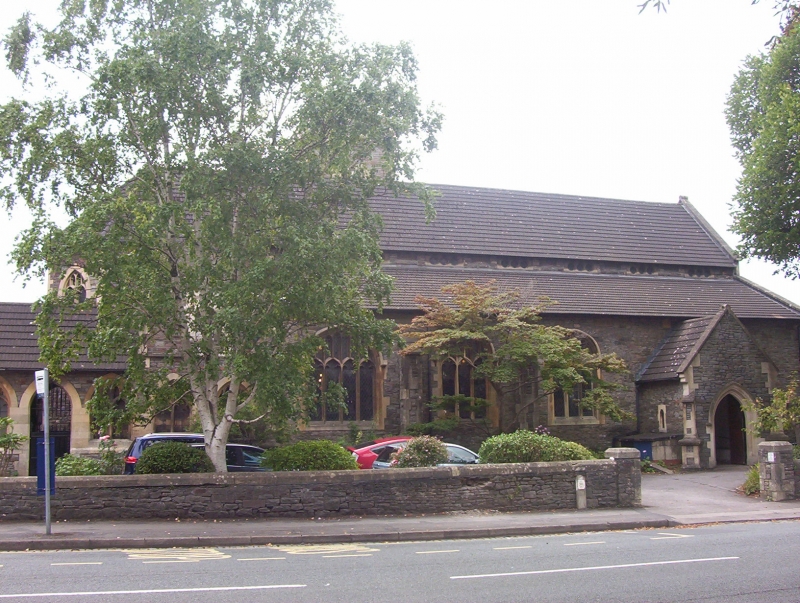
Congregational chapel, now an Anglican church. 1842-3. By W Butterfield. Apse, tower, S transept and school 1863 by EW Godwin, the apse was moved out one bay in c1890. Pennant rubble with limestone ashlar dressings and a tiled roof. Aisled nave, N porch, S transept, apse and tower. Perpendicular Gothic Revival style. The church is linked to the school by a 5-bay passage of 2-light trefoil-headed windows, the second from the E forming a tall entrance with a iron gate; single-storey school rooms have 2- and 3-light square-headed windows. Apsidal E end with 2-light windows. NE vestry gable has a marble wall memorial within an ogee panel to the 5 Bristol martyrs. 4-bay N aisle of wide 4-centred arched windows, with 4 lights and panel tracery, separated by buttresses with a deep roll moulding to the plinth; W porch has an arched doorway with hollow moulding, diagonal buttresses and coped parapet; the clerestory has triple quatrefoils, unaligned with the aisle windows. The S transept has a gable to the transept gallery stairs and a parapeted wall to the school rooms, with 1-, 2- and 3-light trefoil-headed windows with flat lintels; the stair block has diagonal buttresses, with chamfered corners above them, 2-light Perpendicular windows to the S and W, and a W door reached by a flight of steps. The 3-stage tower in the angle between the transept and the aisle has an octagonal ashlar SW turret which rises above the tower to a crenellated top; the tower incorporated Butterfield's reset aisle window into the ground stage to the W; above it is a 3-light flat-headed window, an arrow slit to the second stage and paired single lights with Perpendicular panel tracery and ashlar bands to the belfry; a drip course with gargoyles and a crenellated parapet to the top. The W end has a 4-light window above a central door, a 2-light window to the N aisle and a stair tower for the W gallery with a parapet to the S. INTERIOR: a panelled timber reredos in the 1-bay apse, with stilted arches on hexagonal corbel responds to the sides, and an arch-braced vault. Nave arcade of hexagonal piers to 4-centred arches and responds, splayed clerestory windows with shoulders and an arch-braced collar-beam roof. 2-bay S transept and door leading to the tower, with a ramped stone stair with smooth soffit and foliate wrought-iron balustrade; 1863 galleries to the W end and transept with pierced quatrefoils and billet mould, and similar wainscotting. Memorials: wall monument to Arnold Thomas by Eric Gill, 1924, shepherd and sheep carved into the NE nave respond. HISTORICAL NOTE: originally built as Highbury Congregational Chapel and purchased by the Church of England in c1975. Butterfield's first commission, obtained through his family connection with WD Wills the tobacco industrialist. An exceptionally early and unusual example of the application of the Gothic Revival style to nonconformist chapel architecture, including the early work of two major C19 architects. (Gomme A, Jenner M and Little B: Bristol, An Architectural History: Bristol: 1979-: 312).
Listing NGR: ST5821973854
External links are from the relevant listing authority and, where applicable, Wikidata. Wikidata IDs may be related buildings as well as this specific building. If you want to add or update a link, you will need to do so by editing the Wikidata entry.


Other nearby listed buildings