Latitude: 51.9831 / 51°58'58"N
Longitude: -0.5968 / 0°35'48"W
OS Eastings: 496463
OS Northings: 232551
OS Grid: SP964325
Mapcode National: GBR F2D.RWQ
Mapcode Global: VHFQY.LFV4
Plus Code: 9C3XXCM3+67
Entry Name: Woburn Abbey
Listing Date: 22 October 1952
Grade: I
Source: Historic England
Source ID: 1114006
English Heritage Legacy ID: 38247
ID on this website: 101114006
Location: Central Bedfordshire, MK17
County: Central Bedfordshire
Civil Parish: Woburn
Built-Up Area: Woburn
Traditional County: Bedfordshire
Lieutenancy Area (Ceremonial County): Bedfordshire
Church of England Parish: Woburn
Church of England Diocese: St.Albans
Tagged with: English country house Historic house museum
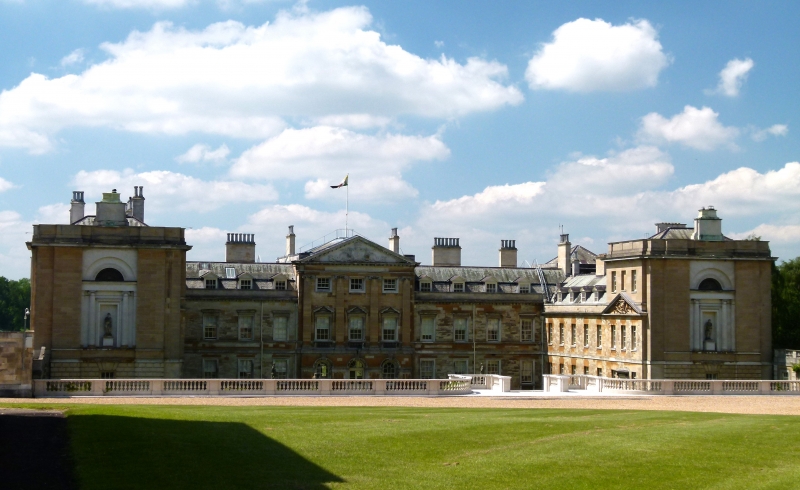
SP 9632-9732 WOBURN WOBURN PARK 10/144 22.10.52 Woburn Abbey GV I Country house, home of the Russells, Dukes of Bedford. Stands on site of and incorporates a little fabric of the Cistercian Abbey (founded 1145 by Hugh de Bolebec) granted to Lord John Russell, later 1st Earl of Bedford, in 1547. Rebuilt c1630 by Francis 4th Earl. Little of this survives due to subsequent reworkings, 1747-61 by Henry Flitcroft (based on plans by John Sanderson) and 1787-1790 by Henry Holland. Lesser contributions by William Chambers. Ashlar, mostly Ketton oolite and Totternhoe clunch. Slated Mansard roofs. Formerly of quadrangular plan, but E wing and E ends of N and S wings demolished 1949-50, after which Sir Albert Richardson added pavilions to N and S wings. 2 storeys and attics, with 3-storeyed pavilions. N elevation: irregular. 3-bay C17 facade survives fairly intact to RH two-thirds, with heavily rusticated loggia to ground floor of central bay and round-arched niches between windows of both floors of outer bays. Whole elevation has sash windows in variety of openings and surrounds, those to C17 part symmetrically arranged. W (now front) elevation: by Flitcroft. Symmetrical, with central pedimented block and pavilions to outer angles. 1:5:3:5:1 windows, all sashes with glazing bars. Outer pavilions have Venetian windows to first floor and Diocletian windows to 2nd floor. Other first floor windows have eared architraves and triangular pediments, the central 3 with broken pediments. Ground floor is rusticated. Central block ground floor has 3 round arches, central one containing part-glazed double doors, outer ones sashes. Above this are 4 engaged giant order Ionic columns. Tympanum has carved Russell achievement. Balustraded parapets to lower blocks, behind which are gabled dormers. Variety of multiple chimney stacks. Adjoining main block at both ends are small single-storeyed rusticated blocks. Each has round-arched doorway and balustraded parapet terminating in carved sphinx on rectangular plinth. S elevation: thought to be by Chambers but heavily reworked by Holland. Truncate, although symmetry maintained by Richardson's work. Ground is banked higher to S side than elsewhere, being at first floor level of building. Main block is same height as pavilions, giving a 2-storeyed facade. 2:9:2 sash windows with glazing bars. Ground floor windows are full-length, with shouldered architraves and triangular pediments. Those to outer bays are set into shallow round-arched recesses. Balustraded parapet. Stone-flagged terrace runs whole length of elevation. Interior: some C17 features, particularly the ornate grotto to N wing, attributed to Isaac de Caux, with nymphs, putti, masks etc in carved stone and inlaid shells. Elsewhere mostly rich ornamentation from the Flitcroft and Holland alterations. Many chimney pieces by Rysbrack and Deval. S range contains Holland's tripartite library. N range includes room with Chinese wallpaper showing birds, plants and trees and Rococo ceiling. N Pevsner, Buildings of England: Bedfordshire, pp166-170; VCH (Bedfordshire), vol.III, pp459-461; Woburn Abbey visitor's guide, 1983.
Listing NGR: SP9646332551
External links are from the relevant listing authority and, where applicable, Wikidata. Wikidata IDs may be related buildings as well as this specific building. If you want to add or update a link, you will need to do so by editing the Wikidata entry.


Other nearby listed buildings