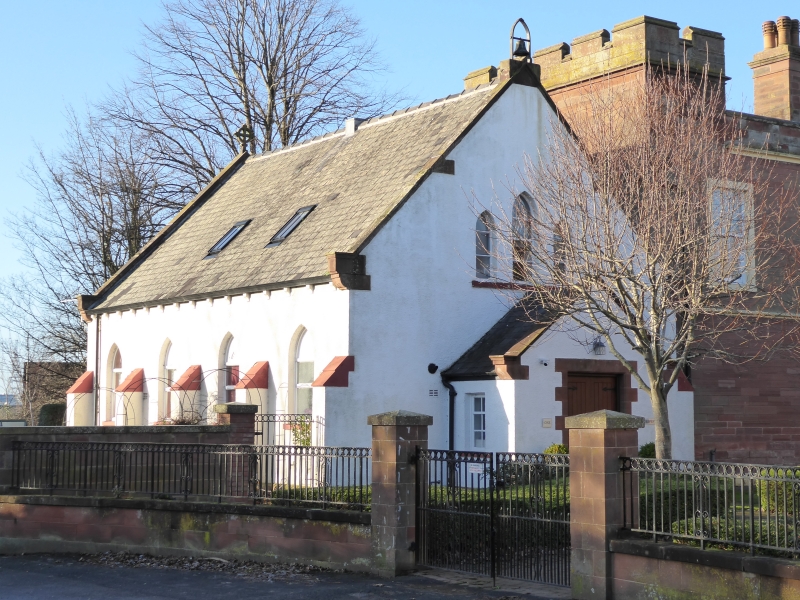
Latitude: 54.889 / 54°53'20"N
Longitude: -2.8935 / 2°53'36"W
OS Eastings: 342784
OS Northings: 555283
OS Grid: NY427552
Mapcode National: GBR 8C7X.C6
Mapcode Global: WH803.JCCV
Plus Code: 9C6VV4Q4+JJ
Entry Name: Durranhill House
Listing Date: 11 April 1994
Grade: II
Source: Historic England
Source ID: 1292498
English Heritage Legacy ID: 386704
ID on this website: 101292498
Location: Botcherby, Cumberland, Cumbria, CA1
County: Cumberland
District: Carlisle
Parish: Non Civil Parish
Built-Up Area: Carlisle
Traditional County: Cumberland
Lieutenancy Area (Ceremonial County): Cumbria
Church of England Parish: Carlisle, Harraby St Elizabeth
Church of England Diocese: Carlisle
Tagged with: House
CARLISLE
NY45NW DURRANHILL ROAD
671-1/2/115 (North West side)
Durranhill House
II
Also known as: Sacred Heart Convent DURRANHILL ROAD.
House, now convent. c1811, with 1830s extensions (date of 1862
on rainwater head appears to have no significance), all for
Richard Lowry with chapel of 1909 and other extensions.
Snecked red sandstone ashlar on chamfered plinth, with
V-jointed quoins, cornice and solid parapet; battlemented
parapet on extensions. Local slate roof on original house;
hipped graduated greenslate roof on extensions, ashlar ridge
chimney stacks.
The garden front (the rear as viewed from the road) is the
original 2-storey, 3-bay house with a left 2-bay wing. The
right wing is replaced (but partly incorporated) by a
2-storey, 7-bay extension, forming an overall L-shape.
Original house has central panelled and partly-glazed door
with fanlight within a prostyle Tuscan Porch, up steps.
Flanking full-height bowed windows with tripartite sashes in
stone architraves, single over entrance. Left wing has sash
windows in stone architraves.
The extension has a single bay in line with the facade;
squared battlemented bay window has 4-light mullions and
transoms; 3-light similar window above under hoodmould. The
7-bay return has off-centre 2-bay projection. Ground floor
2-light casement windows and sash windows above with glazing
bars, all in painted stone surrounds under hoodmoulds. The
extension ends with the parapet carried up as a mock tower.
Viewed from the road, a courtyard leads to a 5-bay facade,
added to the rear of the original house. Central pointed
Gothic arch under a hoodmould with recessed porch. Sash
windows with glazing bars in pointed stone surrounds under
hoodmoulds, 1:3:1, the outer bays slightly projecting. Similar
windows on the extension.
INTERIOR has alterations of different periods but retains much
original detail; an elaborate moulded plaster ceiling in a
now-divided room, partly with false ceilings, compares with
ceilings in Coledale Hall, Newtown Road, of 1810. Hall has
ribbed plaster ceiling and painted doors in Gothic style. Some
coloured marble fireplaces in original house and extension.
Internal panelled shutters at some windows and panelled doors
in fluted wooden surrounds. Staircase has wooden treads,
turned balusters and moulded wooden handrail.
HISTORY: The Lowry family were of "Durnhill" before the
present house, see CR Hudlestone and RS Boumphrey (1978). An
unexecuted design for the house of Richard Lowry is published
in P Nicholson (1812-19), and A Taylor in Country Life (1989)
dates the present house to 1811. Richard Lowry died in a fall
from his horse in 1841, aged 66 and is buried in Wetheral
graveyard; the house was then let by his daughter to various
tenants. The eventual sale of the house to an order of nuns is
recorded in Carlisle Journal (1906) and R Clerkin (1983).
(Hudlestone, C Roy: Cumberland Families and Heraldry: 1978-:
P.211; Nicholson, Peter: The Architectural Dictionary:
1812-1819: P.102, PL.III; Country Life: Taylor, Angus: 31
August 1989: The Dukery of Carlisle: P.95; Carlisle Journal:
19 January 1906; SHJM: Clerkin, Rosemary: A Heart for Others:
1983-: P.63).
Listing NGR: NY4278455283
External links are from the relevant listing authority and, where applicable, Wikidata. Wikidata IDs may be related buildings as well as this specific building. If you want to add or update a link, you will need to do so by editing the Wikidata entry.


Other nearby listed buildings