Latitude: 52.1104 / 52°6'37"N
Longitude: -2.0776 / 2°4'39"W
OS Eastings: 394785
OS Northings: 245789
OS Grid: SO947457
Mapcode National: GBR 2JM.PKZ
Mapcode Global: VH938.Y710
Plus Code: 9C4V4W6C+5X
Entry Name: Abbey Church of Holy Cross with Saint Edburgha
Listing Date: 11 February 1965
Last Amended: 30 March 1999
Grade: I
Source: Historic England
Source ID: 1387027
English Heritage Legacy ID: 474443
ID on this website: 101387027
Location: Pershore, Wychavon, Worcestershire, WR10
County: Worcestershire
District: Wychavon
Civil Parish: Pershore
Built-Up Area: Pershore
Traditional County: Worcestershire
Lieutenancy Area (Ceremonial County): Worcestershire
Church of England Parish: Pershore
Church of England Diocese: Worcester
Tagged with: Church building
SO 9445; 648-1/5/93
PERSHORE,
CHURCH WALK (west side)
Abbey Church of Holy Cross with St Edburgha
(Formerly Listed as: Abbey Church of Holy Cross)
11/02/65
GV
I
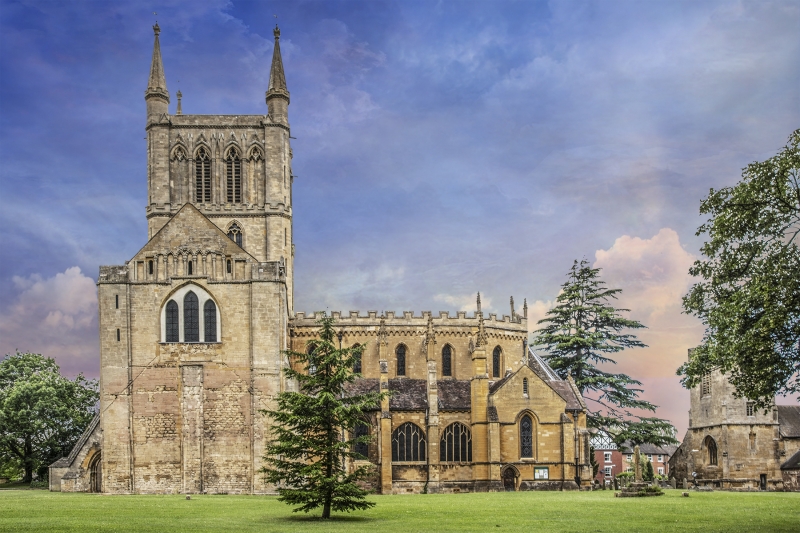
Abbey, now parish church. Founded C7; present building C11-C13
with some later-medieval remodelling; some C17 buttressing
following Dissolution; major restoration 1860s by Giles
Gilbert Scott; further alterations early C20.
MATERIALS: mainly of limestone ashlar with parapeted plain
tile, stone-tile and lead roofs.
PLAN: apse; chancel with choir aisles, N and S transepts and
crossing tower; the nave demolished at Dissolution.
EXTERIOR: C19 apse has narrow lancets with continuous
hoodmould; diagonal buttresses with offsets; corbel table; and
steeply pitched roof.
Chancel N aisle has moulded single-light windows; continuous
hoodmould; plain corbel table; moulded plinth; offset
buttresses which have moulded strings and crocketed pinnacles
with geometric blind tracery and rise as flying buttresses
extending to clerestory.
N clerestory has single-light windows with deep moulded
embrasures surmounted by continuous hoodmould; lombard frieze
and embattled parapet; polygonal E end surmounted by crocketed
pinnacles.
NE chapel has coped gable with apex stone and Perpendicular
tracery to its E window. S chancel aisle similar to N aisle
with Perpendicular E, SE and S windows; clasping buttresses,
some incorporating slender 3/4 round shafts; blocked pointed
and moulded arch to former S transept chapel with clustered
shaft piers and remains of springing to vaulting.
South transept: mostly Romanesque. Its E wall has two further
attached moulded pointed arches with blocked round-arched
features; adjacent are three bays of C13 crocketed blind arcading
of former sedilia and piscina, with quatrefoil mouldings;
embattled parapet with lombard frieze incorporating
grotesques.
South transept S wall: chevron-moulded blind arcading to
gable, interspersed with single round-headed lights;
cable-moulded string course; remodelled triple lancet window;
roofline of former monastic buildings visible; central pier
and blocked doorway.
South transept W wall: similar lombard frieze; roofline of
former nave S aisle visible, and blocked aisle round arch with
adjacent 3-light Perpendicular window and lancets to corner
stair turret.
West wall has blocked round-headed crossing arch with
relieving arch above; remains of nave and arcade walls have
Romanesque piers with cushion capitals; heavily moulded former
S doorway of six orders with stiff leaf capitals to E; inserted
W window and door; the W wall all now heavily buttressed.
North transept: remodelled and reinforced, but retains blocked
round-headed arch to former N nave arcade.
Tower: of four stages, completed 1330; four octagonal pinnacles,
embattled at base, surmounted by large crockets with
weathervanes; ringing chamber has four windows to each side,
of two lights with geometric tracery, each central pair louvred
and flanked by blind outer windows; ballflower-moulded string
course and parapet; third stage has embattled string course with
ballflower mouldings at base and 2-light windows with
trefoil-headed tracery; on W side, former nave roof-line is
visible and small blocked round-arched window; on E, N and S
sides, former chancel and transept roof-lines interrupt
2nd-stage windows; lancets to staircase corner turrets.
INTERIOR: comprises apse and former chancel of five bays, now
used as church, and crossing with nave truncated at W arch.
E apse, built C19 in Early English style on site of former
Lady Chapel, is 5-sided with three narrow lancets to E end flanked
by triple-arched blind arcades, all with narrow pointed
moulded arches, stiff leaf capitals and detached shafts, some
of Purbeck marble; vault has heavily-moulded ribs and central
boss.
Chancel: rebuilt following fire in 1223, has polygonal E end
with pointed E arch of six orders with roll mouldings supported
by stiff-leaf capitals above clustered piers of detached or
3/4 round shafts, some of Purbeck marble; similar, unmarbled,
piers to chancel arcades; combined triforium and clerestory,
rising above moulded string course, incorporate single pointed
lights within triple pointed-arched arcades of tall clustered
shafts with stiff-leaf capitals, blind at E end; tierceron
vaults have ribs rising from stiff-leaf corbels and stiff-leaf
bosses.
Aisles: slender attached piers of clustered shafts with
stiff-leaf capitals and quadripartite vaults with roll-moulded
ribs; N aisle lancet windows are all moulded with shafts and
stiff-leaf decoration.
NE chapel: moulded piscina in S wall and trefoil-headed
shallow niche on E wall; S aisle has mainly Perpendicular
windows; SE chapel has medieval floor tiles and moulded
piscina in S wall.
North transept: blocked Romanesque arch with moulded capitals
to N choir aisle; above this, a later adapted opening, a
blocked opening, and former roof-line; taller Romanesque arch
with cushion capitals to former nave N aisle.
South transept: mainly Romanesque; roll-moulded arch with
cushion capitals to S choir aisle; wider arch to former E
chapel, now blocked and with inserted later-medieval blind
arcading of eight bays of cusped tracery surmounted by coving with
leaf motifs; a deep, splayed, moulded round-arched window;
blocked doorway above; remains of bead-moulded blind arcading,
now shaftless, extends around SE and S walls; above is a
Romanesque triforium arcade with heavy capitals rising from
partly-moulded string course; similar clerestory arcade above
with four pierced quatrefoils in S wall; round arch to SW
staircase turret; blocked tall S nave aisle arch, as N aisle
arch; cross-vault with moulded ribs and leaf bosses
incorporating shields along ridge rib.
Crossing has tall round arches with double 3/4 round shafts
and some figurative, but mainly cushion, capitals; above, in
tower, are 2 tiers of trefoil-headed arcading with
heavily-moulded and partly-embattled string courses, part
blind and part incorporating 2-light tower windows with
trefoil heads, set back behind detached shafts; unusual
bellcage erected 1864 by Gilbert Scott.
FITTINGS: Romanesque font at NW with seated figures under
billet-moulded arcade; replaced lower pedestal and cover.
Benefaction board to Henry Smith and others, 1626, on NE tower
arch, has a painted inscription on painted boards within
moulded wooden frame. C18 hatchment over N entrance, of
painted canvas with motto Resurgam; further hatchments in SE
transept with inscriptions Morses Omnibus Communis and In
Coelo Quies.
MONUMENTS: freestanding effigies in S transept include: to E,
an abbot, possibly William de Harvington or Abbot Hert, on
tomb chest incorporating quatrefoils; to W, a cross-legged
knight in chain mail, possibly Sir William de Harley, C13; on
SW wall, painted Haselwood wall monument commemorates Thomas,
d.1624, Elizabeth, and Sir Francis, and comprises one
recumbent and 2 kneeling figures, a blank inscription panel
within cartouche to rear, 3 free-standing piers supporting
elaborately-carved arms, and chest with strapwork panels and
scagliola decoration; further monument to Fulke and Dorothy
Haselwood has 9 children in relief; other modest C18 and C19
wall monuments; in S transept, free-standing war memorial with
cast bronze figure of Immortality by Alfred Drury; many ledger
slabs in floor throughout.
Parchment inspeximus of the Royal Privileges of the Abbey of
Pershore, 1453, in metal case fixed to crossing S wall.
C19 wallpainting in medieval style to W wall of crossing;
traces of medieval wallpainting on crossing piers.
Section of late-medieval woodcarving incorporating inscription
in NE transept; late-medieval wooden chest against W wall.
STAINED GLASS: includes windows by Clayton and Bell, Hardman
and Co and Kempe.
(BoE: Pevsner N: Worcestershire: Harmondsworth: 1968-; Wilson
M: Pershore Abbey: Much Wenlock: 1994-).
Listing NGR: SO9478845793
This List entry has been amended to add sources for War Memorials Online and the War Memorials Register. These sources were not used in the compilation of this List entry but are added here as a guide for further reading, 27 October 2017.
External links are from the relevant listing authority and, where applicable, Wikidata. Wikidata IDs may be related buildings as well as this specific building. If you want to add or update a link, you will need to do so by editing the Wikidata entry.


Other nearby listed buildings