Latitude: 51.4941 / 51°29'38"N
Longitude: 0.0719 / 0°4'18"E
OS Eastings: 543929
OS Northings: 179271
OS Grid: TQ439792
Mapcode National: GBR NJ.QS4
Mapcode Global: VHHNK.6QC0
Plus Code: 9F32F3VC+JQ
Entry Name: Royal Arsenal Building 20
Listing Date: 9 July 1997
Grade: II
Source: Historic England
Source ID: 1245204
English Heritage Legacy ID: 468764
ID on this website: 101245204
Location: Royal Arsenal West, Greenwich, London, SE18
County: London
District: Greenwich
Electoral Ward/Division: Woolwich Riverside
Parish: Non Civil Parish
Built-Up Area: Greenwich
Traditional County: Kent
Lieutenancy Area (Ceremonial County): Greater London
Church of England Parish: Woolwich St Mary Magdalene with St Michael and All Angels
Church of England Diocese: Southwark
Tagged with: Architectural structure
TQ4479 PLUMSTEAD ROAD SE18
(North side)
786- /9/10065 Royal Arsenal
Building 20
GV II
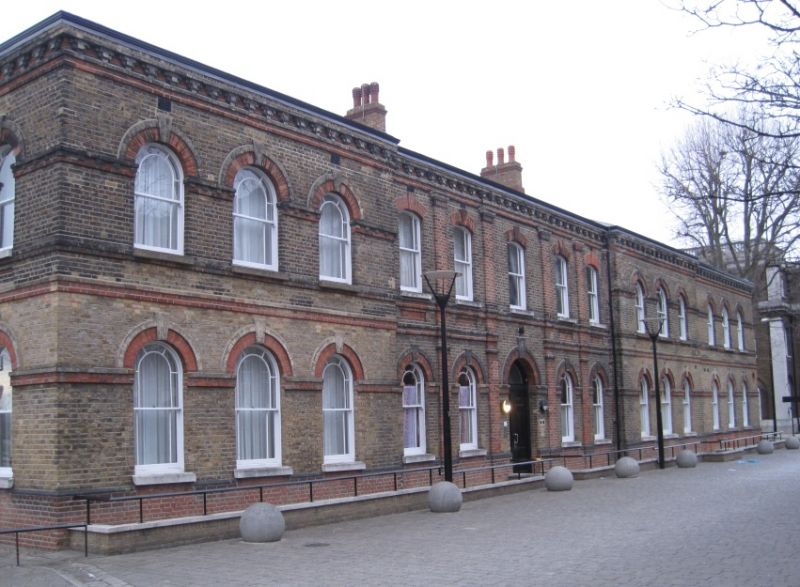
Chemistry laboratory, now office. 1864, designed for Sir Frederick Augustus Abel, War Department Chemist, extended to E and S in 1885, 1903 and 1913. Yellow brick with red brick dressings, ridge stacks and slate roof Double-depth plan, extended to east and north. 2 storeys; 11-window range. Symmetrical front with plinth, moulded impost bands and first-floor ci1l band and brick eaves cornice, the recessed middle 5-bay range articulated by pilasters with moulded capitals. Central round-arched doorway has a fanlight and door with 8 raised diamong panels, and rubbed brick keyed round-arched sashes with margin panes. Similar 3-window side elevations and 3x3 bay blocks to rear, one with glazed clerestorey. INTERIOR: contains a central dogleg stair with ornate cast-iron balusters and twisted newel, curtail and moulded railings, axial passage and panelled doors. The left-hand room open to the roof which has cast-iron elliptical arches with open spandrels on moulded corbels, spanning the room and with similar arches to the hips, and a timber balcony all round on foliate cast-iron brackets with railings as the stair. Historical note: This was the first custom-built laboratory in the Arsenal. Its function is clearly expressed through the design of the laboratory itself, the open left-hand room allowing fumes to disperse from the lab benches. The E wing housed the early photographic section of the War Department. Formerly had iron balconies at both ends. Included as very early purpose-built chemical laboratory, exemplifying the role of the chemist as the most significant factor in the advance of research and development in the post-1850s period in Europe.
Listing NGR: TQ4392979271
External links are from the relevant listing authority and, where applicable, Wikidata. Wikidata IDs may be related buildings as well as this specific building. If you want to add or update a link, you will need to do so by editing the Wikidata entry.


Other nearby listed buildings